May 2026 Newsletter
Updates on AI for Community We’ve been busy! May has been a full month of trainings, and we’re continuing to add more. Hot Off the Press Tip of the Month … Read more
When I have a research report that really matters to me, I run multiple “deep research” queries on all three AI services (ChatGPT, Gemini, Claude), then feed those results to Claude’s Opus model (highest-end currently), and ask Claude to combine & synthesize one final report. I ask it to identify and resolve any contradictions between the reports via additional deep research. And if, at the end, it has unresolved issues, to call those out at the end of the report as items for me to dig into.
A blog post I came across recently offered a reframe that I think is genuinely useful: instead of thinking of AI as a coworker or assistant, think of it as an exoskeleton.
The idea is that an exoskeleton doesn’t replace you, it amplifies what you can already do. Ford uses exoskeletons on assembly lines so workers can hold tools overhead for hours without the physical strain. BMW uses them so workers can carry heavy parts without injury. The exoskeleton makes the person more capable, but the person still has to know what they’re doing.
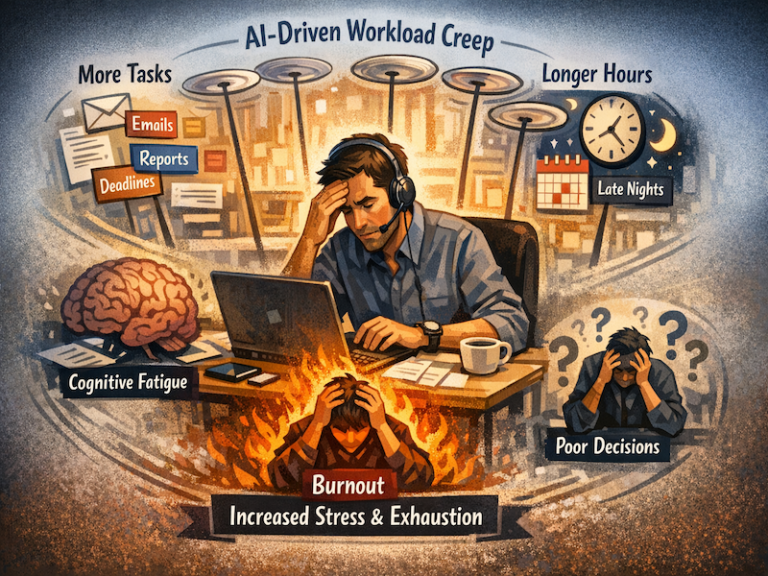
[The] report identified a few key reasons for why this was happening, including task expansion and more multi-tasking. Both of which I’ve definitely experienced over the past year. I can do so much more when I’m leveraging AI, but it also feels like I’ve got 20 spinning plates, and I have to keep them all going or I’m somehow failing.
Something I talk about in training is how useful it can be to have free-form text fields in survey forms. It’s now possible to have AI do a reasonable job of analyzing this text and extracting insights, whereas in the past nobody wanted to slog through reading a bunch of forms – which is why everything was all yes/no or rate on a scale of 1 to 5. In a similar manner, it’s now possible to have AI extract useful insights from archival data
In companies with significant AI adoption, there’s a new issue involving “swim lanes”. In the past, a marketing person typically wouldn’t implement a prototype, and a programmer wouldn’t propose a marketing plan. But with recent AI models, both of those examples now happen. A non-programmer can do “vibe coding” using sites like Loveable to quickly turn an idea into a prototype. And a programmer can use AI to craft a pretty solid marketing plan. Which means you see toes getting stepped on. It’s going to be interesting watching how companies handle this. They can try to enforce swim lanes, but in doing so they hamper innovation.
All of the big 3 AI services now support “learn modes”. Each one is a bit different, but they all are trying to provide a better experience using AI to learn about a new topic. In my use case, I was trying to understand what a friend’s antibody therapeutics company does – I know it’s for treating cancer, but not much more. So the question I asked ChatGPT was: Explain “full-length human IgG bispecific and and trispecific antibodies that bind to multiple targets” to someone who has a technical background and a college degree, but knows very little about cancer treatments. ChatGPT walked me through an increasingly deep explanation, and then started asking questions to see whether I was retaining the information.
Asking AI for diverse ideas gets you more diverse ideas. OK, sounds lame, but it’s actually pretty cool. This is the research paper, but the idea is to add something to your prompt that asks the AI to generate results with more variance. This helps avoid you being trapped in the “bland, generic, same-old” response trap that exists in all of the current AIs. For example, instead of saying “Tell me five jokes about nonprofits”, which returns fairly uninspiring results. Try this prompt: “Tell me a joke about nonprofits. Generate 5 responses to that query, each within a separate
You can now edit images directly inside ChatGPT. For example, you can upload an image and then ask it to make a specific change. Here’s a snippet from a flyer I uploaded. I prompted ChatGPT with “Modify this image, by changing the times from 1:30pm – 3:30pm to 9:30am – 11:30am”. So….not exactly what I wanted 🙂 In theory you could ask it to tweak the background, adjust colors, or remove text. I haven’t tried this, but you should be able to generate variations of an image, like turning a photo into a hand-drawn sketch style.
This is Your Brain on ChatGPT. The MIT Media Center published a paper on the cognitive impact of using AI when writing. Ethan Mollick had a good response to this, which I (mostly) agree with. I think the key point he brings up is that all new technologies have both positive and negative impacts, with two examples being calculators (the fear that we won’t be able to do math in our heads) and cell phones (we won’t remember phone numbers) – both of which weren’t exactly earth-shattering, though note I said cell phones, not smart phones, which is a whole different story.